You can subscribe to this blog

Wednesday, October 26, 2011

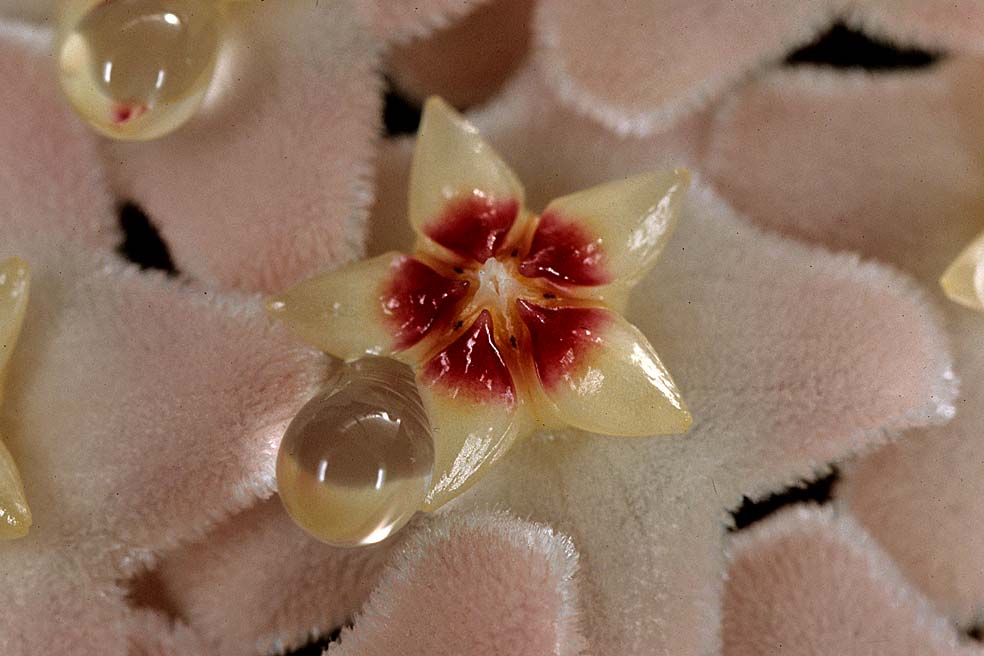
Wax plant, Hoya carnosa, Asclepiadaceae

The flowers of Hoya carnosa, with their massive drops of glistening nectar, remind me of Man Ray's famous photographs of fake glass tears on a woman's face. They seem as surreal as his photographs - but are genuine enough; whenever I've grown this plant I've had to spend a lot of time cleaning off the black mould that tends to grow on leaves splashed with the sugary secretion. Apparently Victorians like to wear Hoya inflorescences in their coat buttonholes - presumably removing those sticky drops first.
Those petals are pretty extraordinary too - they look as though they're made of fake pink fur.


I've seen bees visiting H.carnosa in my conservatory but it's hard to find information on its natural pollinators in the wild. It seems likely that they are nocturnal moths because there are two published studies which show that there is a circadian rhythm of scent emission (1) and nectar secretion peaking at around midnight (2). Members of the Asclepiadaceae have an unusual pollination mechanism, where insects carry away the whole anthers, as a structure known as the pollinium, that attaches to them via an organ called a translator - similar to the pollination mechanism found in orchids. You can see sketches of Hoya pollinia here
Those massive nectar droplets must be the moth's reward for its exertions.
Hoya carnosa seems to have a wide distribution in South East Asia but old gardening books I've consulted indicate that it was introduced to Britain from Queensland in 1802. It's named after Thomas Hoy, who was the Duke of Northumberland's gardener at Syon House at that time. 

The plant seems to flower most prolifically if it's confined to  pots that are not too large and is kept fairly dry in winter. 

Bibliographic references: [1] Planta 174, 242-247 (1988); [2] Botanica Helvetica 116, 1-7 (2006)

Friday, September 16, 2011

Coral Drops, Bessera elegans, Asparagaceae

Garden plants drift in and out of fashion and this vibrant, late summer-flowering species seems to have been well enough known in Edwardian times to feature in popular gardening dictionaries, but in half a century of gardening I'd never encountered it - until I found its bulbs on sale in a local garden centre earlier this year. In The Illustrated Dictionary of Gardening, edited by George Nicholson who was Curator at the Royal Botanic Gardens, Kew in the latter years of the 19th. century, it's described as "an elegant little half-hardy, squill-like bulbous plant from Mexico" and Nicholson's advice for growing it holds good today, even though the 'bulbs' he mentions are actually corms. "It requires good drainage [and] .... if cultivated in pots, a plentiful supply of water from commencement of growth until ripening off", he recommended. I've grown it in pots in my conservatory, followed his century-old instructions to the letter and been rewarded this month with a display of these scarlet flowers, with their blue stamens and style. They're held aloft on 30cm.tall stems, as shown in the illustration below that must have been produced at around the time that the plant was first grown in British gardens. It deserves to be more widely grown today, even though it's not hardy - so you need to dry off and store its corms after the foliage dies down in autumn.
There seems to be some controversy about the classificaton of the plant and the Pacific Bulb Society, which has some useful information on the species, mentions that recent opinion places it in the family Themidaceae, whch I've never encountered before. Their web site illustrates a strikingly coloured purple cultivar and also mentions that Bessera may be synonymous with the very similar genus Behria: all very confusing.


[Image from Edwards's Botanical Register; Consisting of Coloured Figures of Exotic Plants Cultivated in British Gardens; with their History and Mode of Treatment. London 25: t. 34 (1839). Source: http://en.wikipedia.org/wiki/File:34_Bessera_elegans.jpg ]

Wednesday, August 10, 2011

Dodder, Cuscuta sp., Convolvulaceae

Mel, over at Sandy Wildlife has posted a fascinating piece about Dodder Cuscuta europaea, one of the most interesting British native flowering species, that has no root system of its own but parasitises other plants. Her post (highly recommended) is full of fascinating information about the plant and its history but I thought I would add a little about growing it. Some years ago I was given some dodder seed, which I germinated on wet paper towel (germination took about a week), then transferred the spindly seedlings to the soil surface around the base of a stinging nettle Urtica dioica plant in a flower pot. The seedlings elongate quickly and the yellow growing point rotates in a circular motion as it elongates (circumnutation) , until it touches the host plant stem. Once it makes contact there is a delay of a few days and them something remarkable happens...
........ the slender thread swells massively and then coils around the host stem. At this stage it looks more like a reptile than a plant. This transformation takes place because the dodder shoot tip has produced an invasive haustorium that has penetrated the host stem and linked up with its victim's vascular tissue, so now it can divert nutrients from its host to support the new aggressive phase of growth.
After that invasion is very rapid. The dodder branches and wherever it makes contact with the host it 'plugs-in' another haustorium - here you can see haustoria penerating the nettle stem, just a little way up from the bottom of the photo above. It often coils around itself but it seems that the haustoria can't penetrate the plant's own stems.
This is a thin transverse section, just one cell thick, cut through the point of contact between the dodder and nettle stems, seen under the microscope. The dodder stem is the darker tissue, top left, and you can see its haustorium puncturing the outer layers of nettle stem cells. If you look closely (click for a larger image) you can see the tip of the haustorium dividing into finger-like files of cells that are heading towards the host's vascular bundles (labelled V) that are conducting water, minerals and sugars within the nettle.
Once multiple haustoria have established the parasitic dodder grows very rapidly and then....

... flowers prolifically. The small white flowers are produced in clusters.  A fascinating plant - a vampire of the vegetable kingdom.

Saturday, July 30, 2011

Garden Nasturtium, Tropaeolum majus, Tropaeolaceae

I think garden nasturtiums Tropaeolum majus were probably the first plants that I ever grew when I was a child. They are perfect for kids - large seeds for small fingers, reliably fast-growing, tolerant of almost any soil, colourful, long-flowering and harmless (edible, even).

Tropaeolum majus comes from South America, from the Andean foothills from Bolivia to Columbia, and has been grown in Britain since around 1686. It naturally has orange flowers, as in the top photo here, and grows in the wild as a climber, with prehensile leaf stalks (petioles). Successive cycles of selection and possibly hybridisation produced numerous varieties including dwarf, compact (Tom Thumb) forms and double cultivars that were popular in Victorian and Edwardian Britain. Today it's almost always raised from seed but in the 19th. century numerous named varieties were bred and propagated from cuttings that were overwintered in heated greenhouses, and were said by William Robinson, in his English Flower Garden, to produce more flowers and fewer leaves if grown in this way.

There are various accounts as to how the plant acquired its generic name. All say that Tropaeolum owes its name to the martial connotations of its shield-like leaves and helmet-like flower shape, but there are differing opinions on whether the name was derived from Greek or Latin. In Roman times a tropeum was a trophy pole used to display the armour and helmets of vanquished enemies, and some say Linnaeus consequently used the derived name Tropaeolum for the genus, recognising that the leaves resembled shields and the flower, when tilted downwards, looked like an elaborate helmet. Others say that Linnaeus derived the generic name from the Greek tropaion, meaning a trophy, for essentially the same reason

Nasturtium nectar is hidden deep inside the long spur (see top photo) formed from the sepals and long-tongued insects have to force their way into the mouth of the flower to reach it, although I have seen bumblebees that have learned to go around to the back of the flower and bit through the nectar spur to reach the nectar. John Gerard, in his General Historie of Plantes, mentions that these flowers were also known as lark's heel, on account of the spur that resembles the claw on a lark's foot.

There was, until recently, considerable debate about the evolutionary relationships of the garden nasturtium family, the Tropaeolaceae, with other plant families and for a long time it was belived to be related to geraniums (Geraniaceae), but modern molecular biological techniques, using DNA sequencing, shows that it is related to the cabbage family (Brassicaceae) and is one of 15 related families that all contain compounds called glucosinolates.
Interestingly, the large white butterfly Pieris brassicae that breeds on cabbage also took to breeding on this South American plant when it was introduced to Britain. I suspect that the butterfly's sensitive antennae, attuned to detecting the volatile chemical signals that identify suitable food plants for its caterpillars, must have detected the biochemical similarities between garden nasturtium and cabbage long before biochemists came to the same conclusion.

Saturday, June 25, 2011

Plantago major rosularis, Plantaginaceae

This strange mutant of the greater plantain Plantago major has been documented for over 400 years. It's commonly known as the rose plantain and at first sight the flower bears little relation to....

... the flower spike of the normal wild-type plant. Greater plantain could be described as one of the dullest flowering plants in the British flora, but the 'rose' mutant is really something rather extraordinary.

Mutants like this were described and depicted in John Gerard's Herball or General Historie of Plants, published in 1597, and have been grown as curiosities in gardens ever since.
 Four hundred years after the woodcuts of mutant greater plantains appeared in Gerard's Herball you can still buy seeds of similar plants.

The normal inflorescence of greater plantain looks like a green rat's tail and to appreciate it's relationship with this green rose-like structure you first need to look at the mutant inflorescence in side view, when.....


... you can see that it's composed of a spiral whorl of spoon-shaped bracts. If you compare these with .....

... the individual flowers of a short section of the spike of the wild-type plant you'll see that the latter has a tiny green leafy bract under each individual flower. All that has happened in the mutant is that the tiny bract has just kept on growing, until it has produced  a large green petal-like structure under each flower. The other effect of the mutant has been to stop the elongation of the inflorescence spike, so the longitudinal axis has been telescoped, producing a  rose-like inflorescence.

If you look at the basal green 'petals' of the rose mutant you can see the other floral parts - the ovary (beginning to swell) and the withered stigma and stamens - sitting there at its base, just as they do in the wild-type.

Here I've cut the whole mutant inflorescence vertically in half so you can see the compressed longitudinal axis. If these green enlarged bracts were brightly coloured you'd be looking at a rather attractive inflorescence!

Looking a little closer still, here you can see an ovary (that will become the seed capsule) at the base of each leafy bract and brown, withered stamens. Normally greater plantain is wind pollinated but it's almost impossible for pollen to escape from between those large green bracts, so the individual flowers always self-pollinate - which is why this mutant, first mentioned in Gerard's Herball four centuries ago, has bred true every since, has survived unchanged as a garden cultivar and can be reliably raised from a packet of seeds.  If this mutant had been able to cross pollinate with the wild type it would be a rare occurrence, turning up sporadically in large populations of the plant.

So, apart from being a botanical curiosity, what else can this mutant tell us about the formation of flowers? Well, it shows how a simple mutation, that allows the bract growth process to go on for longer than normal but turns off the inflorescence elongation process too soon, can have a spectacular effect on the final appearance of a flower and its structures. It demonstrates that a small shift in the timing of developmental events can have a dramatic final outcome, making simple structures more complex (or vice-versa, because it can operate in the reverse direction too). It illustrates how such changes in the development of various components of the flower could have led to the evolution of great variety of flower forms we see today. These days plant scientists studying the genes that produce a flower create artificial mutants of the experimental plant thale cress Arabidopsis thaliana to work out which genes affect the development of each component of the flower and how they interact with one another to produce its final structure. This 400 year-old mutant, known to John Gerard (who was a noted plagiarist and most probably copied the information from earlier herbalists), gives us another insight into that process.

Friday, June 3, 2011

Cocao,Theobroma cacao,Malvaceae

I like a nice cup of cacoa - and this is where it comes from. This is the flower of cacao, Theobroma cacao, source of chocolate. These flowers - only about a centimetre across - are pollinated by small insects - notably midges - and then the cacao pod develops (see below).

The tiny cacao flowers are produced in large numbers and are unusual in that they sprout directly from the bark of the tree - a botanical trait known as cauliflory. The plant was formerly classified in the family in the family Sterculiaceae but more recent systematic research has reclassified it as a member of the mallow family. It originates from the foothills of the equatorial Andes and is thought to have been first domesticated 3000 years ago in Central America, where it became the sacred beverage plant  of the Mayans, who believed it was a gift from the gods - a historical link commemorated in the Latin name that Linnaeus bestowed on the plant - Theobroma literally means 'food of the gods'. The Aztecs used cacao beans as a form of currency. 

To produce chocolate the cacao pods are split open and the seeds are extracted from the pulp, then allowed to ferment for several days and then roasted (when the chocolate flavour develops), then ground into a powder. The highest-valued Criollo cacao has relatively low levels of bitter substances but cacoa powder is usually mixed with milk to offset the bitterness. About 3.7 million tons are produced annually to satisfy chocaholic cravings, much of it in West Africa, but about 30 per cent of the crop is lost to pests and diseases. It's hoped that the recent sequencing of the cacao genome will speed-up the selection of disease resistant varieties.

This gent - Sir Hans Sloane, 1660-1753, commemorated with this statue in Chelsea Physic Garden , of which he was patron - is credited with bringing cacao to Britain from Jamaica.  Sloane was a physician and was interested in its medicinal properties but found that it was far more palatable if mixed with milk, inventing a patented recipe for milk chocolate that was eventually acquired by Cadbury. The original Cadbury's chocolate wrappers carried the inscription Sir Hans Sloane's Milk Chocolate prepared after the original recipe.


Sloane's belief in the medicinal properties of chocolate have been echoed for over a century in this illustration on the tin of Droste's cacao, a Dutch brand - where a nurse is shown delivering the drink to the patient. Notice how the image on the tin is repeated in the tin she is carrying on her tray - this cunning advertising image reinforcement, of an advert within an advert, has become known as the Droste Effect.


Thursday, May 19, 2011

Adam's Laburnum, +Laburnocytisus adami, Fabaceae

In 1825 a French nurseryman called Monsieur Adam grafted a purple-flowered specimen of broom Chamaecytisus purpureus onto a yellow laburnum Laburnum anagyroides stem, hoping to create the broom equivalent of a standard rose. Instead he created a strange graft chimaera - a tree with the tissues of both parents intermingled, that produces three different kinds of flowers.  The core of the tree is laburnum, sheathed in layers of broom cells, and the whole arrangement is unstable. In the picture above you can see what appears to be a broom bush sprouting from the branch of the tree, looking like an unusually colourful mistletoe.

This picture, and the one below, show the profusion of purple broom flowers on slender, pliable stems......


... and is probably quite close to what Adam had in mind when he started his experiment, except that he would have hoped to produce this head of flowers on top of a single straight stem.


The whole tree, which looks like a rather lax, poorly growing laburnum in general shape, produces a second form of inflorescence .....

.... that looks like a dangling salmon-pink laburnum blossom - a blend of flower colours of both parents.
Look closely and you can see a hint of laburnum yellow towards the rear of these flowers ....

... but higher up on the tree, amongst the pink blooms, it also produces occasional pure yellow, typical laburnum flowers....
... which you can see here.

This example, of what is a rather rare tree, is currently flowering in Durham University Botanic Garden

In graft hybrids like this the cells of both parents coexist as separate genetic entities in a single organism. You could, at least theoretically, extract cells of each component, put them through sterile tissue culture and recover the two original parents. A similar graft hybrid between hawthorn and medlar, +Crataegomespilus, has also been produced but is rarely found in collections. The + before the Latin name indicates that the plant is a blend of cells from two parents that maintain their independent genetic identity, rather than being the result of sexual hybridisation.

Grafting, which has been most often used in viticulture, fruit tree and rose production was once viewed by many as being a very unnatural practice, comparable with the way many view genetic engineering today. In his poem The Mower, Against Gardens, Andrew Marvell (1621-1678) wrote:

Another world was searched through oceans new,

To find the marvel of Peru;
And yet these rarities might be allowed
To man, that sovereign thing and proud, Had he not dealt between the bark and tree,
Forbidden mixtures there to see.
No plant now knew the stock from which it came ;
He grafts upon the wild the tame,
That the uncertain and adulterate fruit
Might put the palate in dispute.


Genetic engineering has yet to produce anything in the horticultural world that's as extraordinary as Adam's Laburnum.