You can subscribe to this blog

Showing posts with label Carnivorous plants. Show all posts

Thursday, January 13, 2011

Butterwort, Pinguicula moranensis, Lentibulariaceae


Carnivorous plants have a problem. On the one hand, they must catch and digest insects to supplement the meagre soil nitrogen supplies in the boggy habitats that they inhabit. On the other hand, they depend on insects to pollinate their flowers, so there is no future in 'biting the hands that feed them' to the extend that they produce no seed. So most tend to have flowers that are well separated from their lethal, carnivorous leaves by a long flower stem - and this attractive butterwort from Mexico, Pinguicula moranensis, is no exception.
This species makes an excellent plant for the cool conservatory, for two reasons. One is that it produces these attractive magenta blooms from late autumn right through until early summer.


The second reason is that it's a formidable consumer of several annoying greenhouse pests, including whitefly, greenfly and those annoying little mushroom gnats that tend to come with many brands of today's potting composts. The way in which small insects are attracted to the glutinous glands on the leaves and are then trapped and digested is very satisying - and you can see some examples of butterwort's insect catching prowess here. This plant is flowering flypaper.
This species is very easy plant to propagate - just pull the leaves away from the leaf rosette and insert each to a depth of about 5mm. in a moist compost. Buds will develop at each leaf base, to produce a new rosette, much as they do when you propagate an African violet or Streptocarpus species.
Place butterworts amongst your conservatory plants and they will act as a form of botanical biological insect control; they won't eliminate your pest problems but they will produce tangible evidence that they are making inroads into the insect pest population. This plant comes with a feelgood factor if you are troubled by tiny winged insect pests.
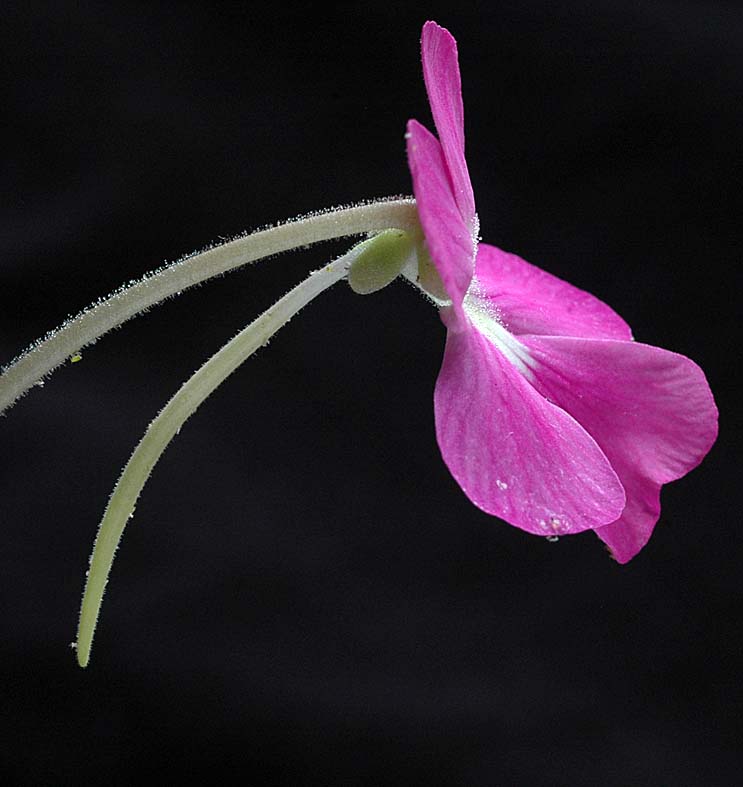
Seen from the side, it's clear that this butterwort's flowers must be pollinated by long-tongued butterflies, landing in the flat-faced flower and probing with a long proboscis to the bottom of that long nectar spur behind the flower. The flower is the only part of the plant without adhsive and digestive glands - look closely at the flower stalk (double-click) and you can see here that it's coated with adhesive glands that have caught a few tiny greenfly.

Tuesday, March 9, 2010

Sarracenia spp. Trumpet Pitcher


It's understandable that people admire Sarracenia plants for their funnel-shaped pitfall traps that catch and drown insects but in many ways their flowers are equally remarkable..... and their purpose is to lure insects for pollination rather than as a food source, so this is a Jekyll-and-Hyde plant. Each flower consists of five sepals that expand as the bud opens, arching downwards above the rest of the floral structure.

Below hang five petals, shaped like tongues, protruding from gaps in the weird, inverted umbrella-shaped stigma that is suspended from a style in the centre of the flower that leads to the ovary and ovules (hidden from view in these photographs). There's a very fine cutaway illustration here that identifies all the key structures. Bees crawl along the petal and in through those curved indentations that you can see around the edge of the 'inverted umbrella'. Once inside they collect pollen or deliver it to the tips of one of the five receptive stigmas that are at the apex of each of the upwards curving, greenish bands of thickening visible between the petals. It can be quite a struggle for the bees to force their way in and out again.


When they are in full flower the blooms have a scent that's reminiscent of a bed of stinging nettles on a hot summer's day, although in the green-flowered species above (Sarracenia flava) it smells of cat urine - which must be attractive to bees but makes this plant unsuitable for growing on your kitchen windowsill.


The flowers appear in spring, before a new crop of pitchers is produced, and in the bud stage they're reminiscent of a rather elegant art deco lamp. The flowers are a nectar source for bees but the pitchers are also a potential death trap, so the blooms are elevated in long stems well above the deadly pitchers. The scent of the flowers seems to be a powerful attractant to bees - if I leave my conservatory doors open during the flowering period, in early spring, the room soon fills with eager bumblebees, newly emerged from hibernation and desperate to get at the flowers.

Sarracenia species are native to North America. Some species are hardy (although the winter we've just had will have put that statement to the test) and S.purpurea is naturalised in the wild in Ireland and in the Lake District.

For more information about carnivorous plants take a look at  http://www.thecps.org.uk/