You can subscribe to this blog

Thursday, November 10, 2011

Water hyacinth, Eichhornia crassipes, Pontederiaceae


Water hyacinth Eichhornia crassipes is often rated as one of the world's top ten worst weeds, thanks to its prodigious capacity to spread over the surface of lakes and rivers. It's said that just one plant can multiply to cover an acre of lake surface in eight months, thanks to its ability to produce stolons that sprout new plants from their tips. While vegetative spread explains its local abundance, its short-lived but beautiful flowers have also played a part in its current worldwide distribution in the tropics. It comes from South America but is now a problem in Africa, India and the Far East where it has been introduced as an ornamental species that has quickly rampaged out of control. It carpets parts of Lake Victoria in Africa, impeding navigation,  and within a year of being introduced onto the Sudanese Nile in 1957 it had spread along 620 miles of river.


Water hyacinth isn't hardy in Britain, although there were a couple of reports of it surviving outside through the winter in Norfolk a few years ago. The last two severe winters would certainly have killed any plants in garden ponds, but it does make an attractive plant for a conservatory. Here it's sharing its indoor pond with another notorious aquatic weed, water lettuce Pistia stratiotes, which is equally prolific.


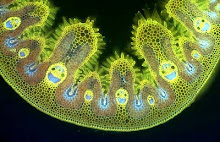
Water hyacinth owes its buoyancy to these inflated leaf petioles. When you cut these open ...


... you find that they are sub-divided into hundreds of small, rectangular compartments with thin walls of papery cells.

Although water hyacinth is a problematic weed there's a lot of research going in into useful applications of this plant. These include bioremediation - using its capacity to absorb and sequester toxic metals like mercury, chrome, lead, cadmium, zinc and arsenic via its fibrous root system that dangles in the water. Numerous trials have been carried out for waste water treatment. It has also been used as animal feed (from plants grown on clean water) and there's extensive research into using its rapid biomass production as a source of energy, by using the harvested plants to produce biogas or bioethanol.

10 comments:

  1. Wow I love the texture and artistic design of the cut bouyancy petioles. A lot of introduced species are wrecking havoc in these country, including plants, fish and other animals. This water lily last year flooded a province in Mindanao for the first time, and they used buckhoes and diggers to let water freely flow to the sea. In Luzon, many enterprising NGO used the dried stalks to make bags and baskets, so they become source of livelihood instead of environment burden.

    ReplyDelete
  2. Paul Shirley succulents sell cuttings for one and a half Euros.........

    Mine has bloomed prolifically all summer and has just moved to the dark corner of the living room for a winter rest. It was a successful treatment last year, so will be routine from now on.

    If you can wait I'll happily pop a young cutting in the post next spring.

    ReplyDelete
  3. ignore my last comment - I had two of your posts on different tabs and commented on the wrong one!

    ReplyDelete
  4. I pomyśleć, że te rośliny, które są ozdobą oczka wodnego, potrafią robić takie szkody :-(. Pozdrawiam

    ReplyDelete
  5. Hi Andrea, I remember seeing what I think was this plant around the edge of paddy fields when I visited the Philippines, and I recall seeing some big rafts of it floating down the river in Manila...

    ReplyDelete
  6. Just found your blog through blotanicals. Quite impressive work you've done.
    Yes,I have a love/hate relationship with this plant. Bioremediation would put it to good use. It can make dirty pond water crystal clear in days. Beautiful flower as well.
    It escaped during a flood in Louisiana and now is in the entire SE part of the U.S.
    It is NOT the worst villain, though.
    It doesn't hold a candle to Giant Salvia...a nightmare floater on our lakes here in Texas.
    David/:-)

    ReplyDelete
  7. Added comment on the history of this plant in SE United States
    Water Hyacinth introduction:
    Cotton Exchange Exposition
    New Orleans, Louisiana
    1884
    David/:-)

    ReplyDelete
  8. Hi David, thanks for visiting and for the fascinating information. I've noticed that when you keep the plant in aquarium tanks there's very little algal growth on the glass ... it must produce some interesting root secretions....

    ReplyDelete