You can subscribe to this blog

Wednesday, October 16, 2013

Decaisnea fargesii, Dead Man's Fingers, Lardizabalaceae


Mention the word 'autumn' and what colours spring to mind?  Most likely crimson, scarlet, orange, yellow, russet, gold ......... but probably not blue. But that's the colour of the eye-catching fruits of Decaisnea fargesii, ripening in Durham University Botanic Garden today.


This large shrub has attractive, long, pinnate leaves ........


...... grey-green below .....


....... and darker green above, but it's those fruits that make it special. It's hardy so I'm surprised it's not more widely planted. The colour of the pods is most vivid on sunny days, so must be partly due to the reflective properties of the pod surface, in addition to the underlying pigmentation. 


The seeds are surrounded by a jelly-like pulp that's said to be edible but insipid.

Decaisnea fargesii comes from western China 

Saturday, October 5, 2013

Colchicum autumnale, Meadow Saffron or Autumn Crocus, Colchicaceae


Meadow saffron, sometimes known as autumn crocus, also has the rather salacious name of 'naked ladies' which supposedly stems from its lack of leaves when the flowers appear in autumn; the leaves sprout in spring and wither away in summer. The lilac flowers are very attractive to bees.

 This is a rare British native wild plant and most specimens that turn up – like those above, beside a road in Weardale – are garden escapes. To my mind they perform best when grown in grass like those in the photograph; when they’re cultivated in bare soil the floral tubes often grow very long and the flowers fall over in the autumn wind and rain, but some surrounding grass gives them support.


The plant has a long history of cultivation and in 1776 the botanist and doctor William Withering, writing in his Botanical Arrangement of all the Vegetables Growing in Great Britain mentioned that ‘cultivation produces a great variety of colours and makes the blossoms double’.

 In the wild meadow saffron was ruthlessly eliminated because it’s extremely poisonous to grazing livestock, thanks to the presence of toxic colchicine in all parts of the plant. Like many plant poisons colchicine has been used medicinally, in very low doses, to treat gout. Benjamin Franklin, himself a gout sufferer, is supposed to have introduced the plant to the United States for that very purpose. There have been accidental fatalities with poisoning from either eating the plant (its leaves resemble very lush wild garlic) or using it as herbal medicine at lethal concentrations, so one wonders how many of those who followed William Withering’s advice survived, when he wrote ‘This is one of those plants that upon the concurrent testimony of ages was condemned as poisonous; but Dr. Storck of Vienna hath taught us that it is a useful medicine. The roots have a good deal of acrimony. An infusion of them in vinegar, formed into a syrop by the addition of sugar or honey, is found to be a very useful pectoral and diuretic. It seems in its virtues very much to resemble squill, but it is less nauseous and less acrimonious’.

Colchicine is used by plant breeders to double the number of chromosomes in plants, because the drug allows the chromosomes to divide without the cell they are in dividing, so doubling the number of chromosomes in the cell - a phenomenon known as polyploidy. More chromosomes per cell tend to produce larger cells and larger cells lead to larger plants and better crops.


All sorts of unnaturally large plants, ranging from strawberries to hyacinths, have been bred using this long-standing form of genetic manipulation, which has been in use for over a century. Crossing a colchicine-induced tetraploid, which has double the normal chromosone complement, with a diploid plant that has the normal complement of chromosomes produces plants called triploids, with three sets of chromosomes per cell, which are seed- sterile – a common breeding technique for producing seedless fruit such as bananas.


Sunday, September 29, 2013

Violent Violas


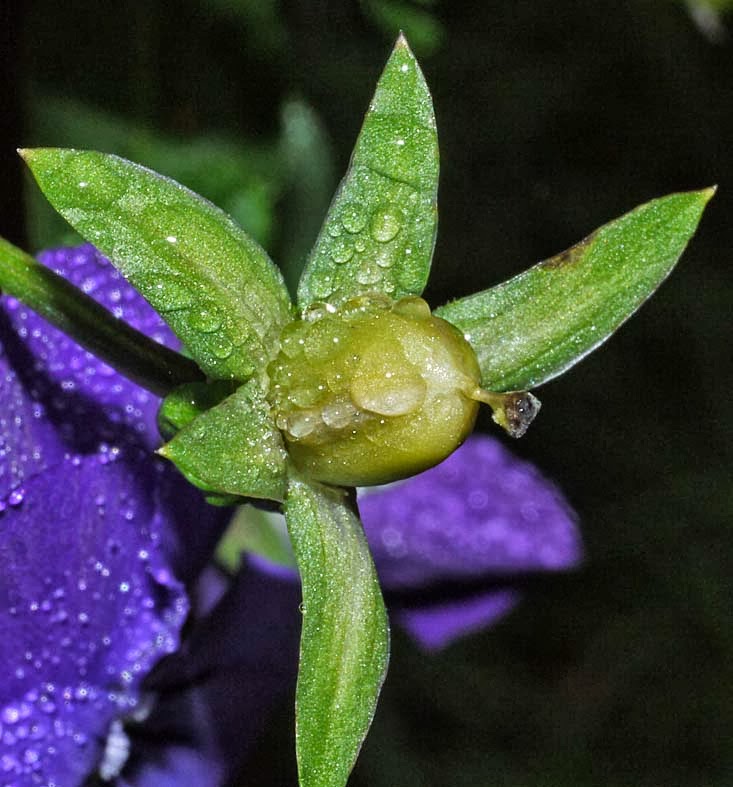
You'd never imagine that flowers with such 'cute little faces' could be capable of such violence ......


....... after the flowers of most  members of the Violaceae, including violets, pansies and violas, have been pollinated the seeds develop inside a capsule .....


...... which splits into three segments when it ripens, then as the walls of the split capsule segments dry out they curl inwards, squeezing the rows of slippery seeds .....


....... until they fire them out, like a bar of soap slipping out of your wet hands in the shower.


This photograph was taken a couple of seconds after the one above and during that time the capsule fired out three of the six seeds in that segment that points to 11 o'clock. Two of the seeds hit the lens filter with an audible ping and the third hit me square in the forehead.

No wonder 'volunteer' violas and violets germinate all over our garden.............


Saturday, April 27, 2013

Beautiful buds


One of the joys of spring is to watch buds develop and then burst - exquisite shapes with all the beauty of the flowers packaged within. 


Daffodil


Aloe variegata


Sambucus racemosa


 Blackcurrant


Horse chestnut


Horse chestnut


Hyacinth


Rhododendron dauricum


Erythronium 'Pagoda'


Marsh marigold Caltha palustris


Ash Fraxinus excelsior flower buds


Sycamore Acer pseudoplatanus

Thursday, April 18, 2013

Pasque flower, Pulsatilla vulgaris, Ranunculaceae


Pasque flower usually flowers in our garden around Eastertide, but this year an early Easter and an exceptionally late spring means that the flowers are only just opening. I particularly like the covering of fine silky hairs that trap water droplets on misty mornings.


Pulsatilla vulgaris is a rare and endangered species of calcareous grassland in England, now confined to just a few locations. Many of its old sites have been ploughed up. In the wild the plant often grows in nutrient-poor soils and is usually quite small, with only a couple of flowers, but cultivated varieties grown in better soil conditions are far more floriferous. The secret of long term cultivation seems to be to grow it in very well-drained soils in a sunny spot. 

After the flowers have finished the feathery seed heads stay attached to the plant for several weeks. I've found that the best way to grow the plants from seed is to sow them soon after they're ripe - stored seed has much poorer germination.

It think it's a charming plant, nicely summed up by William Robinson in The English Flower Garden: "There are few sights more pleasant to the lover of spring flowers", he wrote, "than to see its purple blooms just showing through the hard grass on a bleak down on an early spring day".

Tuesday, March 12, 2013

Cyclamen hederifolium, Primulaceae

I was never a great fan of Cyclamen until I started buying this little beauty, C.hederifolium, as a winter house plant. It ticks all the boxes: attractive foliage; compact and very floriferous form; long-lasting (some that I bought back in December are still in bloom); sweetly scented (at least the white-flowered varieties are - I can't detect much scent in the darker pink and red varieties); and it's cheap - the nursery where I buy them sells them for £1 each. 


One particularly attractive feature of Cyclamen is the shape of the flower buds, that are twisted like the swirl of a dancer's skirt.


The only tricky thing about growing this little beauty is remembering not to over-water it. The densely packed leaves and flowers succumb to Botrytis at the stem bases if you do.


Tuesday, February 5, 2013

Viburnum x bodnantense 'Dawn', Adoxaceae


The darkest days of winter in our garden have been brightened by the scented flowers of Viburnum bodnantense 'Dawn', which has been in bloom continuously since late November. The first flowers tend to be damaged by the worst of the winter weather but the recent ones, now it's a little milder, have a more intense colour. The twigs make good cut flowers for a small vase because the flowers are borne on their tips and open to perfection indoors.


V. x bodnantense is a hybrid between V. farreri and V. grandiflorum, raised at Bodnant in North Wales in 1935.

It used to be thought that Viburnum belonged to the honeysuckle family, Caprifoliaceae, but recent molecular studies using DNA sequencing have shown it to be a member of the family Adoxaceae. Forty years ago, when I was a trainee botanist, the Adoxaceae was believed to contain just a single species, town-hall clock Adoxa moschatellina but, as is so often the case, molecular biology has revealed unsuspected phylogenetic relationships.