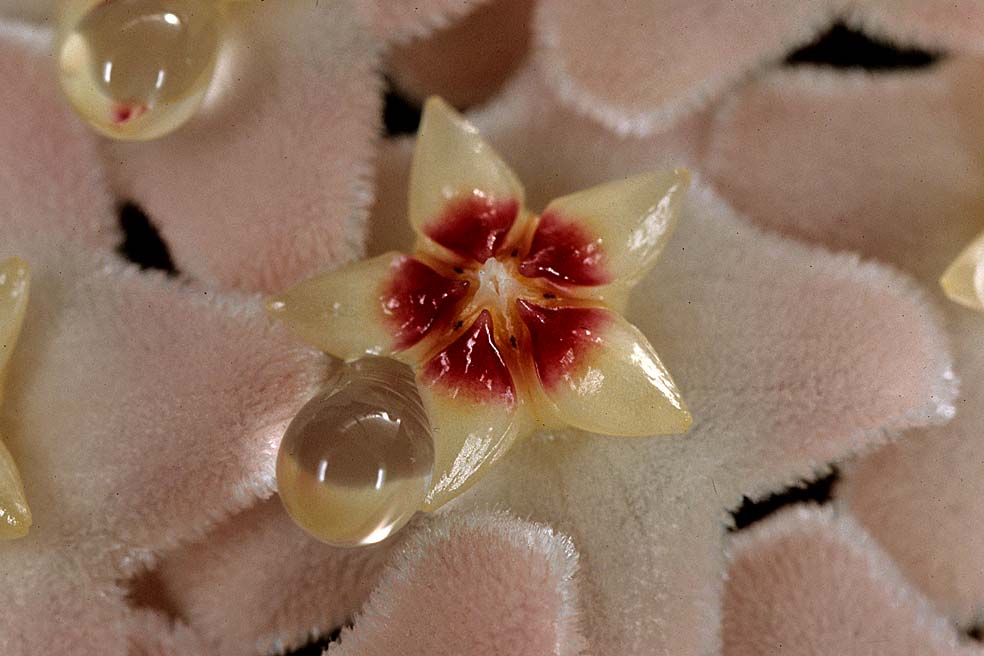
The flowers of Hoya carnosa, with their massive drops of glistening nectar, remind me of Man Ray's famous photographs of fake glass tears on a woman's face. They seem as surreal as his photographs - but are genuine enough; whenever I've grown this plant I've had to spend a lot of time cleaning off the black mould that tends to grow on leaves splashed with the sugary secretion. Apparently Victorians like to wear Hoya inflorescences in their coat buttonholes - presumably removing those sticky drops first.
Those petals are pretty extraordinary too - they look as though they're made of fake pink fur.

I've seen bees visiting H.carnosa in my conservatory but it's hard to find information on its natural pollinators in the wild. It seems likely that they are nocturnal moths because there are two published studies which show that there is a circadian rhythm of scent emission (1) and nectar secretion peaking at around midnight (2). Members of the Asclepiadaceae have an unusual pollination mechanism, where insects carry away the whole anthers, as a structure known as the pollinium, that attaches to them via an organ called a translator - similar to the pollination mechanism found in orchids. You can see sketches of Hoya pollinia here.
Those massive nectar droplets must be the moth's reward for its exertions.
Hoya carnosa seems to have a wide distribution in South East Asia but old gardening books I've consulted indicate that it was introduced to Britain from Queensland in 1802. It's named after Thomas Hoy, who was the Duke of Northumberland's gardener at Syon House at that time.
The plant seems to flower most prolifically if it's confined to pots that are not too large and is kept fairly dry in winter.
Bibliographic references: [1] Planta 174, 242-247 (1988); [2] Botanica Helvetica 116, 1-7 (2006)